

As organizations aggressively accelerate cloud adoption and digital transformation, enterprise data management has entered a new era of complexity. Today, data is the lifeblood of business continuity, but moving, protecting, converting, and extracting it across fragmented platforms is a monumental challenge.
Whether your team is executing a high-stakes cloud migration, safeguarding business assets with independent backups, converting legacy archives, or pulling precise records for an urgent compliance audit, your approach to data must be agile.
The Reality Check: Traditional manual methods—rife with custom scripts and heavy IT intervention—are slow, resource-intensive, and prone to human error. Modern enterprises need automated, on-demand data operations capable of processing massive volumes of data efficiently without sacrificing accuracy or integrity.
Why On-Demand Data Operations Matter
Business data is no longer confined to a single server or a neat on-premises repository. Instead, modern information is hyper-distributed across a massive ecosystem:
-
Productivity Hubs: Microsoft 365, Google Workspace
-
Communication Channels: Live email servers, archived threads
-
Storage Frameworks: Cloud storage platforms, unstructured file repositories
-
Business Tech: Enterprise applications, legacy software systems
As these data volumes grow exponentially, businesses face frequent, complex requirements that demand immediate attention:
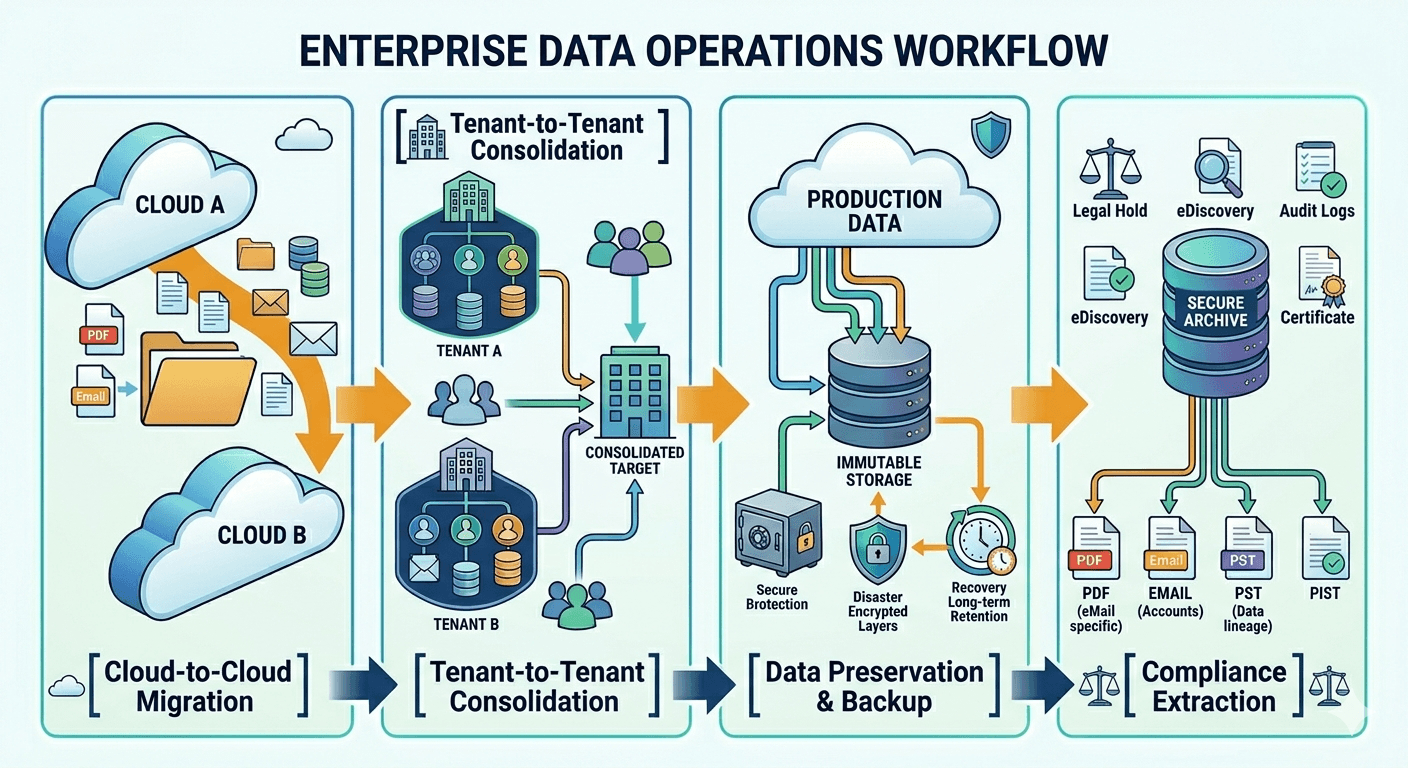
Without a structured, automated approach, these projects quickly devolve into costly, time-consuming bottlenecks that disrupt daily business operations.
The Core Challenges of Enterprise Data Management
Managing enterprise-grade data at scale introduces several friction points that can stall digital transformation initiatives:
1. Mass Volume Pressures
Organizations routinely need to process millions of emails, files, and database records simultaneously while trying to maintain baseline platform performance and accuracy.
2. Format Incompatibility
Legacy systems often store critical information in outdated, proprietary structures that simply do not play nice with modern cloud architecture.
3. Data Integrity Risks
During any migration or conversion project, preserving metadata, complex folder hierarchies, user permissions, and original timestamps is non-negotiable for compliance and business context.
4. Stringent Compliance Demands
Highly regulated industries face strict legal mandates to retain, archive, and retrieve historical data instantly to satisfy legal, forensic, and regulatory discovery requests.
5. Operational Downtime
Data operations must occur seamlessly in the background. Businesses cannot afford to take critical systems offline or impact employee productivity.
4 Critical Data Operations Enterprises Need Today
To maintain agility, modern organizations must master four fundamental data capabilities:
Cloud Backup and Data Preservation
Securing cloud data against accidental deletion, cyber threats, ransomware, and operational failures is vital. A robust preservation strategy guarantees long-term visibility and business continuity, keeping historical records completely intact.
Seamless Data Migration
As infrastructure modernizes, data must move securely between various cloud platforms, tenants, and applications. Successful execution requires intelligent automation and end-to-end validation to minimize downtime and eliminate data loss.
Data Conversion and Normalization
Legacy applications often lock data inside hard-to-access formats. Data conversion transforms these static archives into standardized, modern file types, restoring long-term usability and accessibility for compliance purposes.
Rapid Data Extraction
When legal audits, internal investigations, or eDiscovery requests hit, speed is everything. Organizations need the ability to isolate and extract specific historical records quickly without drowning in manual labor.
Enter Legacyflo: Powering On-Demand Data Operations
Legacyflo is a highly scalable data operations platform purpose-built to automate and streamline complex data movement across the enterprise lifecycle.
By replacing manual effort with intelligent, hands-free workflows, Legacyflo supports a full spectrum of critical data tasks:
-
Automated Data Migration
-
Secure Data Backup
-
Format Conversion
-
Targeted Data Extraction & Preservation
The Strategic Benefits of Legacyflo
| Feature | Business Impact |
|---|---|
| Accelerated Execution | Automated workflows cut down project timelines from months to days, drastically reducing manual IT strain. |
| Airtight Data Security | Built-in security controls protect sensitive, regulated information during active migration, extraction, and conversion workflows. |
| Enterprise-Grade Scalability | Effortlessly process massive, multi-terabyte datasets across highly distributed hybrid and cloud environments. |
| Audit-Ready Compliance | End-to-end logging and secure data handling provide complete traceability for governance, risk management, and legal audits. |
| Reduced IT Overhead | Eliminates the reliance on brittle custom scripts and resource-intensive human oversight. |
Future-Proofing Your Digital Strategy
Data is your organization’s most valuable asset. Forward-thinking companies no longer view backup, migration, conversion, or extraction as isolated, one-time IT headaches. Instead, they treat Data Operations as an ongoing, strategic business capability.
Legacyflo removes the friction from data movement, enabling your enterprise to build a resilient, future-ready framework. By automating the technical complexities of data lifecycle management, Legacyflo protects your past while freeing your team to focus on future growth, agility, and innovation.
Ready to modernize your data workflows?
Discover how Legacyflo can transform your next migration, conversion, or backup project into a seamless, stress-free operation.